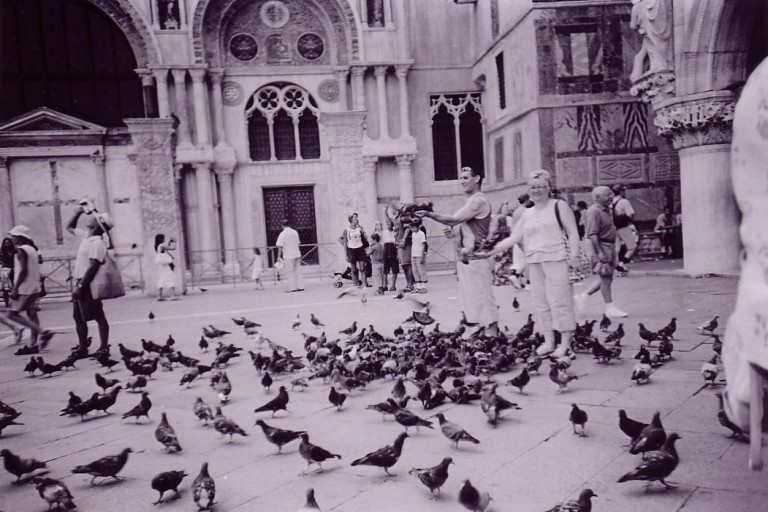
Cycling in an urban environment is not always an unmitigated joy, mostly due to people. In fact, it can often be downright terrifying, frustrating and occasionally embarrassing. Here’s why (with pictures):

1. Pedestrians. The moment that they sense the road is free of motor vehicles, pedestrians will swarm onto it from all directions without looking. There is no discernible pattern to their movement, which is wholly impossible to predict. If you have a bell fitted to your bicycle, you can sound this as you approach. This won’t cause pedestrians to move out of your way, but they will at least look at you as you plough into them. The movement of pedestrians in cycle lanes is easier to predict. They won’t move out of the way at all, as they are apparently mesmerised by all of the pretty pictures of bicycles they can see there.

2. Pedals. No serious cyclist uses standard pedals and you’ll find that anyone with a remote interest in cycling is attached to their pedals, either by clips, or using a clip-less system. This is lovely for generating a lot of power, but an absolute nightmare when maneuvering in dense traffic, where cyclists often need to put their feet down. This is why you often find the riders of cooler, more expensive bikes laying in the road at traffic lights, having come to a standstill and forgotten to extricate themselves from their pedals, which causes them to fall over (it always seems to happen in slow-motion). Well, either they’ve forgotten, or they’ve had some sort of equipment malfunction. In my experience, the larger the audience, the more likely you are to have that malfunction.

3. Distraction. There are many distractions that endanger the urban cyclist: girls in summer clothing, other bicycles, local landmarks and, as I discovered on Monday, shop windows. So distracted was I by my own reflection in a window that I cruised slowly into the back of a car which had come to a halt in front of me, causing many people on a bus to laugh. It was very undignified.

4. Temptation. There are many temptations in an urban environment and it’s easy to succumb to them. While no one would dream of having a few beers and getting behind the wheel of a car, it is perfectly acceptable to have a few beers and then push your bicycle home. But pushing your bicycle is boring and dull and, when you find yourself alone, away from traffic and pedestrians on a deserted riverside cycle path, for example, it’s tempting to ride for a bit. This is a mistake, as you will soon realise when you find yourself wobbling outrageously and unable to steer in the direction that you are vaguely aware that you should be heading in. You will feel a growing sense of anxiety as you lurch between heading toward the river, and heading ever-so-slightly less toward the river. In your efforts to avoid the river, you may find that actually ride round in circles. A dry crash counts as a win in this situation.

5. Cars. Cars are the major hazard to urban cyclists, chiefly because there are so many of them. They do many, many stupid things, but perhaps the most irritating thing they do is to straddle the cycle lane while waiting to pull out, thus halting all cyclists who could otherwise have continued along the road. Having pedalled hard to build up momentum only to be halted due to inconsiderate behaviour is infuriating. As you approach them, all of your shouting, waving and bell-ringing will be in vain as the driver will never, ever make eye contact with you, and they certainly aren’t going to back out of the way. Many cyclists kick the cars of these idiots as they make their way around them. If I attempted that, I would probably fall off (see reason 2).

6. Buses. Terrifying behemoths of the urban environment, buses strike fear into the heart of cyclists. They pull out without any warning and, despite being slower than most bicycles on tight, twisty roads, they will always try to overtake anyway. If you want to see what the face of a terrified and angry cyclist looks like when squashed up against a window, you should sit in a seat on the left hand side of a bus, somewhere near the centre.

7. Taxis. The bette noir of the urban cyclist, the pedestrian, other road users; in fact, all right thinking people. Trying to avoid taxis in an urban environment is challenging indeed. They’re apparently exempt from all of the laws of the road and can seemingly park anywhere, travel at any speed, in any direction, are not obliged to signal and their drivers don’t even need two hands on the wheel. Or even one. Who knows where a taxi will turn up next, or in which direction it may be travelling? Your bike could be struck by a taxi at any moment, even if it’s on the roof-rack of your car or stored in your garden shed. The bloody things pop-up everywhere. They’re a menace.
So, in conclusion, urban cycling is dangerous beyond belief, mostly because all road users – drivers, cyclists and pedestrians alike – are idiots. In fact, all people are idiots, and the further you are from them, the safer you will be. Unless you’re a taxi driver of course, in which case you’re probably immortal.