7 Reasons

Tag: protest

  • 7 Reasons That It’s Not As Bad As You Think

    7 Reasons That It’s Not As Bad As You Think

    Okay!  This is a humour site and my country’s been on fire for the last couple of days, so there’s only really one thing that I can write about today, so let’s be funny about the riots.  Except, no.  That isn’t really going to work, is it?  There are people out there losing their homes and livelihoods as a result of them and I’m sure we all have friends and family that are affected, so writing a lot of nonsense about how good the coverage of the riots will look on a brand new (and free) HD television, or how phoning 999 to report themselves will be so much easier now that everyone with a hooded top has an iPhone would seem trite and foolish.  Fortunately, though, while events may have saddened me and affected my sense of humour, they haven’t affected my spirit, my love of humanity and my wonderment at peoples’ innate capacity for good and their astonishing ingenuity.  Accordingly, here are seven reasons that it’s not as bad as you think.

    1.  Innovative Brilliance.  “Necessity is the mother of invention” said Plato (in Greek, probably) and our brave and hard-working police force need tea.  These lovely people have taken the time out to make them some.  They’ve also devised the absolute best way to use a riot shield.  Is there an image that captures Britain’s spirit better than this?
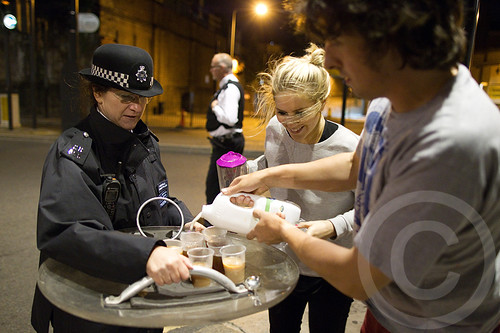
    00:389/8/2011:CamdenTown,London

    2.  Collective Brilliance.  The riots have demonstrated the country’s capacity for collective brilliance.  Many, many people decided that they weren’t going to let their (our) streets be wrecked by the mindless idiocy of a few.  The Twitter account @riotcleanup was set up and it now has almost 80,000 followers.  That’s more people than have been involved in rioting and looting.  People have got together in overwhelming numbers for the power of good.  This picture by @lawcol888 is wonderfully uplifting.

    3.  Individual Brilliance.  Oscar Levant said that there was “a fine line between genius and insanity” and, from that very line, this woman bravely berates rioters and looters.  That there are people in this country courageous and brilliant enough to stand up to a mob so eloquently is wonderful.

    4.  Expectation-Altering-Brilliance.  Stan Collymore (What?  Wait, he’s gone mad.  He’s been lauding examples of brilliance and now he’s writing about Stan Collymore!?), former Premier League footballer and someone that I have occasionally thought of as a bit of an idiot over the years tweeted this earlier:


    Now, professional footballers (and former professional footballers) are often pilloried – sometimes rightly – for behaving poorly and setting a bad example to people and this was unexpected, but it was a cheering and most welcome thing to see, even if he did make me feel like a git.

    5.  Technological Brilliance.  It’s been a while since Britain has seen rioting on this scale and there’ve been a lot of technological advances in the meantime, so it’s fair to say that any online response to it was going to be breaking new ground.  The innovative use of social media as a response to events has been staggering.  Almost as soon as disturbances began in Birmingham yesterday, the rather brilliant @caseyrain set up a Birmingham Riots Tumblr account to document events in the second city while the attention of the national media was focussed on London.  There have been many, many other wonderful examples of innovative use of social media, with Facebook groups (,http://www.facebook.com/londoncleanup), Tumblr accounts (http://catchalooter.tumblr.com/) and websites (http://www.londonrioters.co.uk/identify/) used to promote various causes and to mobilise people into various types of action.  That people have used the internet and social media so effectively to mobilize themselves into making our streets better and catching the looters is both marvellous and demonstrative of a laudable degree of collective will and creativity.  Oh, and the looters are helping by using Facebook too.

    6.  Just Utter Brilliance.  Don’t want the rioting and looting to ruin your evening?  Simple.  Just pretend it isn’t happening.  “Riot, what riot?  I say, could you pass the port, my good man?”

    7.  Historical Brilliance.  The oft-cited high-water-mark of societal unity, sacrifice and collective accomplishment was the way that Britain dealt with the blitz during World War II.  The blitz spirit is something that is often mentioned in articles that decry modern society to illustrate a decline in standards and unity, and many commentators on the current situation have spoken of the riots as being symptomatic of a breakdown in society.  But rioting and looting are nothing new.  During the blitz – that exalted time when our society is seen as having been at its strongest and most cohesive – with a war-depreciated police force and abundance of opportunity there was widespread looting and criminality too.  The truth is that there has always been a sociopathic minority in our country ready to exploit any weakness (lack of police cover, evacuated streets etc) for their own personal gain, regardless of the consequences to others.  That we don’t let the looting during the blitz affect the high regard in which we hold the selfless sacrifice of the majority during the second world war speaks volumes about us.  History tells us that it’s possible to have a strong, dynamic and caring society despite having a minor element that riots and loots.  And the way that the majority of Britain has reacted today to the events of the past few days suggests that little has changed.  That is heartening.
  • 7 Reasons That Britain Should Ban Farting.  Now!

    7 Reasons That Britain Should Ban Farting. Now!

    Malawi is currently blazing a trail in the important field of social hygiene and public decorum.  Recently, as I’m sure you’re aware, Malawi’s Justice Minister, George Chaponda, recently proffered legislation that would outlaw farting in public there.  This is a brilliant proposition, and at 7 Reasons, we firmly believe that Britain should follow Malawi’s inspired lead and adopt this groundbreaking legislation as our own.  Here’s why.

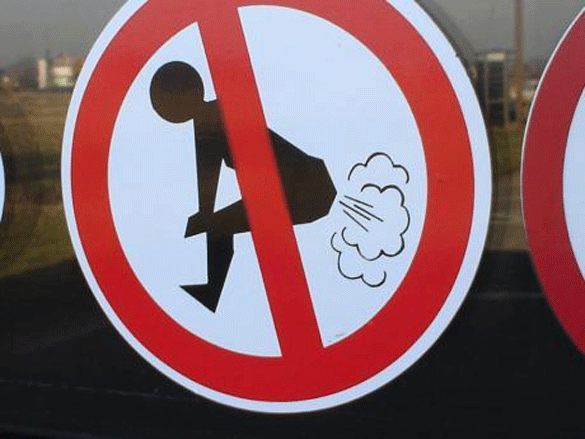
    A no farting road sign

    1.  Job Creation.  The world is in the grip of the worst economic crisis since the Great Depression and unemployment in the UK is rising.  If we were to outlaw public flatulence, however, we would need additional police officers to enforce the new anti-guffing laws.  These new officers would be paid for by funds from a central pot, entirely raised by the levying of anti-arse-methane fines which, in a country where chicken tikka massala is the most popular dish, and mushy peas and cauliflower cheese are also commonly consumed foods would surely be substantial.  It would also be a more efficacious use of police resources too as, currently, since the relaxing of the minimum height requirement, short policemen and women have been burdened with the task of tackling hardened criminals who tower over them.  With the new legislation, however, undersized officers would be more usefully redeployed into the anti-farting branch, where they would be far more effective at flatulence-detection than full-sized officers, who could concentrate on tackling more serious crime.  The sort of stuff that occurs around head-height, rather than lower down.

    2.  Because It’s Disgusting.  The most obvious reason to ban farting in public is that it’s disgusting.  No one wants the air they breathe to be sullied by it having been filtered through the fetid innards of a grubby gentleman who has seems to have been dining on Fray Bentos pies and pickled eggs for the previous – constipated – week, and with the farting ban, we won’t have to.  This fat man can be summarily hauled away by the diddy-police to the fug house rather than being allowed to continue his journey between Kings Cross and York, which is where I encountered him six months ago.*

    3.  Inequality.  Never mind the disputed existence of a glass ceiling in the UK’s wage structure or of gender disparity and ageism in broadcasting, the definitive and most obvious form of sexual inequality in the UK today is apparent in public flatulence.  After all, if a man strikes-up an impromptu butt-trombone solo in public it’s seen as ill-mannered, though somewhat comical and not entirely unacceptable.  If women break wind in public, however (even pregnant ones, for whom bowel control is more difficult than anyone) it is not seen as remotely acceptable.  When a woman lets rip in a public place, monocles pop out of gentlemens’ faces, other ladies gasp and faint, children gape open-mouthed (unwisely) and point: “That lady blew off!” they gasp in astonishment as their parents simultaneously attempt to hush them and shuffle them away from the foul and wretched harridan with the trumping problem.  If we ban farting in public, we’ll all have to hold it in and we’ll put an end to this heinous and iniquitous societal inconsistency.

    4.  Male Grooming.  The overall appearance of the British male will be greatly improved as a result of the ban on flatulence.  After all, when forced to hold it in while in public environs, he will have to resort – like his countrywomen – to more frequent visits to the bathroom to relax and unwind**.  He won’t team up with someone else to visit the bathroom because that’s just weird.  But he will see mirrors that much more often and will consequently adjust his hair more, notice dry patches, take note of errant eyebrows and, as he’ll be exposed to more bathrooms than before, he’ll see how the colour of his clothing works in conjunction with a wider variety of hues.  The nation will smell better and look better.

    5.  Control.  It’s not just that the entire population of Britain will have to control themselves better (sort of a rectal version of the stiff upper lip that made Britain great), we’ll lessen the occurrence of truly abhorrent instances brought about by a disastrous happenstance involving flatulence and intoxication.  Because I was in a busy – and quite respectable – pub once with a group of friends when a man at the next table, who had been imbibing copiously and was now somewhat inebriated, misjudged his attempt at a flatulent emission.  Within half a minute or so it became apparent to the entire pub (except, bizarrely, the man himself and the people at his table) what had occurred and, within a minute many people (including myself) were dry-heaving and within two, most of us were on our way to another pub, tears streaming from our eyes.  If flatulence were illegal, this sort of thing wouldn’t happen.  That was eight years ago, and I haven’t been back to that pub since.  This means that premises that clearly enforce the ban will benefit too, so it’ll further benefit the economy by rewarding well-run businesses.

    6.  Television.  Britain and its society was built on snobbery and the class divide and, with this in mind, the ban on flatulence will be a perfect addition to the nation’s laws.  Now, having seemingly exhausted the Drunken UK Seaside Towns Shellsuited Fighting genre, ITVs 4,5,6,7,8 and 9 and Sky: Whatever will be able to unleash a new wave of prurient “reality” programmes focussing on what common people get up to while the rest of us are safely at home cleaning our Agas and polishing our brogues.  We won’t have to watch grainy CCTV footage of men in short sleeved shirts and shoes that resemble Cornish pasties – or orange women wearing earrings larger than their frocks – fighting at 3am in Blackpool on our televisions any more.  We’ll be able to watch them farting.  This will reinvigorate a whole tired television genre while retaining its appeal to our own innate snobbery, so the ban will have the effect of enriching the cultural life of the nation while dovetailing perfectly with the national characteristic of sneering at the hoi-polloi.

    7.  Anarchy. Another of the cornerstones of the British character is that we’re taught that laws are for the obeyance of fools and the guidance of wise men.  It’s in our heritage to subvert authority and express our individualism by flagrantly flouting the law.  So some people will rail against state oppression by freely indulging their bodily urges as a means of protest.  These anarchists will fart for freedom; they’ll be freedom farters, gallantly and nobly resisting government by liberally cutting the cheese whenever the fancy takes them.  We might not all approve of their actions, but it’ll be a hell of a lot safer than petrol-bombing buildings or throwing bricks at police-horses.  And the “Fart For Freedom” posters will be hilarious.  In fact, this movement will probably be called the FFF and will doubtless become noted for being insubstantial and puffed up with hot air.*** But don’t worry, they’ll be quite harmless.

    *I NEVER forget.

    **I can’t begin to tell you how proud I am of that.

    ***FFF

  • 7 Reasons That The Westbourne Bank Protest Was Stupid

    7 Reasons That The Westbourne Bank Protest Was Stupid

    In Britain, it’s often said that we’re not very good at protesting, and we’re always compared unfavourably with the French in that regard.  But now, public protest in the UK has reached an all-time low because, last weekend, several men in Dorset bricked up the door of their local bank in what they claimed was a, “…protest against the reluctance of banks to lend money to small firms”.  Here are seven reasons that their protest was stupid.

    Barclays bank in Westbourne, Dorset, being bricked in by protesters (Cameron Hope)

    1.  They Went To The Wrong Bank.  The protesters wanted to brick up the door of the Westbourne branch of Natwest Bank because it had refused the group’s ringleader, Cameron Hope, a business loan.  But, when they arrived at the Natwest, the police were nearby, so the group decided to brick up the door of a different bank instead.  Barclays.  Now, if I do something that irritates my wife involving…ooh…I don’t know…umm…a bicycle, for example, and I’m not there when she finds out about it – or I’m standing near the police – I wouldn’t expect her to go and yell at a different man.  Because that would be crazy.  And irrational.  And yes, it would be much better if she did that, but that’s not the point.  Bricking up the door of a bank that they didn’t have a legitimate grievance with is just mad.  And counter-productive.

    2.  Prudence.  Okay, so the bank turned down Cameron Hope’s loan application.  What should he do?  Scrimp and save, perhaps.  Look at alternate ways of raising capital, or go to a different bank.  I’m not a businessman, but I wouldn’t choose to demonstrate my financial acumen and creditworthiness to another bank by frittering my money away on costly building materials and then use them to construct a monument to my own profligacy on their doorstep.  Because that’s not going to help.  And it’s a lot of effort.  He could have achieved the same effect by setting fire to twenty pound notes in front of the bank manager instead.  Far less trouble.

    3.  Put Simply.  The more money the bank has, the more they’ll lend, making it more likely that you’ll get a loan.  Conversely:  The less money the bank has, the less they’ll lend, making it less likely that you’ll get a loan.  So if you brick the door of the bank up, customers can’t take their money to the bank, and then the bank can’t lend it to you.  I realise that this is a highly simplistic, microeconomic description of banking, but I’m addressing it thus, to the protesters because of…

    4.  The Quote.  The quote tells us that the protesters don’t understand how banking works at all, because one of the group stated to journalists, “You go into a bank and there’s nothing there, the bank’s open but the safe is shut.” This is his summary of his grievance with the banking system; and it doesn’t really bear much scrutiny.  Because of course there’s nothing there.  What does this man expect to find in a bank?  Displays of money?  Shelf upon shelf of alluringly-arrayed notes and enticing floor-displays brimming over with a boundless abundance of shimmering coins?  And of course the safe is shut.  It’s a safe.  That’s its job.  If the bloody things weren’t meant to be shut they’d be called something different.  They’d be called unsafes.  Or vulnerables.

    5.  Helping The Bank.  The protesters bricked up the door of the bank on a Sunday:  A day when all banks are closed.  So this had no effect on the bank’s ability to trade.  In fact, one of the major obsessions and expenses of any bank is security, and by bricking up the door – and thereby making it more difficult for robbers to enter the premises – the protesters actually helped the bank.  Not to mention that their protest also brought the police along to stand outside in hi-vis jackets, which probably made the bank as safe as it’s ever been.  And all at no extra cost to the bank.  What are the protesters going to do next, try to bring down the Conservative party by voting for them?

    6.  Consequences.  Though the protest didn’t have any serious consequences, it could well have done.  The protesters could have endangered the nation’s economy.  By bricking up the door of the bank, they made it likely that employees would have to enter and exit the premises via the windows.  And, as history teaches us, bankers jumping out of windows is one of the worst economic indicators that there is.  Worse even than Alistair Darling’s eyebrows.  It’s the sort of thing that, if the media get hold of the footage, can shatter fragile economic confidence.

    7.  Achievement. As a protest against banking it doesn’t appear to have accomplished anything.  I was in the centre of a city yesterday, and banking appeared to be going on pretty much unhindered by the protest. People in polyester uniforms were sitting around near potted plants in waist-high partitioned areas looking depressed, as usual.  The cash machine outside was covered in the remnants of a McDonald’s milkshake, as usual.  I wanted to thump over 90% of the people in the queue, as usual; even myself.  So the protest has had no discernible effect on banking.  Obviously, the protest brought an awful lot of free publicity for the property developer behind it, but that wasn’t the point.  Because this was a protest against banking, right?  And not some sort of tawdry self-serving publicity stunt?