7 Reasons

Tag: Manchester

  • 7 Reasons That It’s Not As Bad As You Think

    7 Reasons That It’s Not As Bad As You Think

    Okay!  This is a humour site and my country’s been on fire for the last couple of days, so there’s only really one thing that I can write about today, so let’s be funny about the riots.  Except, no.  That isn’t really going to work, is it?  There are people out there losing their homes and livelihoods as a result of them and I’m sure we all have friends and family that are affected, so writing a lot of nonsense about how good the coverage of the riots will look on a brand new (and free) HD television, or how phoning 999 to report themselves will be so much easier now that everyone with a hooded top has an iPhone would seem trite and foolish.  Fortunately, though, while events may have saddened me and affected my sense of humour, they haven’t affected my spirit, my love of humanity and my wonderment at peoples’ innate capacity for good and their astonishing ingenuity.  Accordingly, here are seven reasons that it’s not as bad as you think.

    1.  Innovative Brilliance.  “Necessity is the mother of invention” said Plato (in Greek, probably) and our brave and hard-working police force need tea.  These lovely people have taken the time out to make them some.  They’ve also devised the absolute best way to use a riot shield.  Is there an image that captures Britain’s spirit better than this?
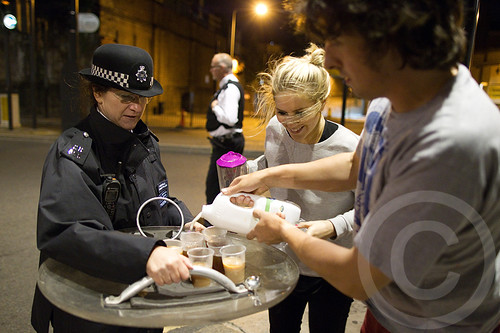
    00:389/8/2011:CamdenTown,London

    2.  Collective Brilliance.  The riots have demonstrated the country’s capacity for collective brilliance.  Many, many people decided that they weren’t going to let their (our) streets be wrecked by the mindless idiocy of a few.  The Twitter account @riotcleanup was set up and it now has almost 80,000 followers.  That’s more people than have been involved in rioting and looting.  People have got together in overwhelming numbers for the power of good.  This picture by @lawcol888 is wonderfully uplifting.

    3.  Individual Brilliance.  Oscar Levant said that there was “a fine line between genius and insanity” and, from that very line, this woman bravely berates rioters and looters.  That there are people in this country courageous and brilliant enough to stand up to a mob so eloquently is wonderful.

    4.  Expectation-Altering-Brilliance.  Stan Collymore (What?  Wait, he’s gone mad.  He’s been lauding examples of brilliance and now he’s writing about Stan Collymore!?), former Premier League footballer and someone that I have occasionally thought of as a bit of an idiot over the years tweeted this earlier:


    Now, professional footballers (and former professional footballers) are often pilloried – sometimes rightly – for behaving poorly and setting a bad example to people and this was unexpected, but it was a cheering and most welcome thing to see, even if he did make me feel like a git.

    5.  Technological Brilliance.  It’s been a while since Britain has seen rioting on this scale and there’ve been a lot of technological advances in the meantime, so it’s fair to say that any online response to it was going to be breaking new ground.  The innovative use of social media as a response to events has been staggering.  Almost as soon as disturbances began in Birmingham yesterday, the rather brilliant @caseyrain set up a Birmingham Riots Tumblr account to document events in the second city while the attention of the national media was focussed on London.  There have been many, many other wonderful examples of innovative use of social media, with Facebook groups (,http://www.facebook.com/londoncleanup), Tumblr accounts (http://catchalooter.tumblr.com/) and websites (http://www.londonrioters.co.uk/identify/) used to promote various causes and to mobilise people into various types of action.  That people have used the internet and social media so effectively to mobilize themselves into making our streets better and catching the looters is both marvellous and demonstrative of a laudable degree of collective will and creativity.  Oh, and the looters are helping by using Facebook too.

    6.  Just Utter Brilliance.  Don’t want the rioting and looting to ruin your evening?  Simple.  Just pretend it isn’t happening.  “Riot, what riot?  I say, could you pass the port, my good man?”

    7.  Historical Brilliance.  The oft-cited high-water-mark of societal unity, sacrifice and collective accomplishment was the way that Britain dealt with the blitz during World War II.  The blitz spirit is something that is often mentioned in articles that decry modern society to illustrate a decline in standards and unity, and many commentators on the current situation have spoken of the riots as being symptomatic of a breakdown in society.  But rioting and looting are nothing new.  During the blitz – that exalted time when our society is seen as having been at its strongest and most cohesive – with a war-depreciated police force and abundance of opportunity there was widespread looting and criminality too.  The truth is that there has always been a sociopathic minority in our country ready to exploit any weakness (lack of police cover, evacuated streets etc) for their own personal gain, regardless of the consequences to others.  That we don’t let the looting during the blitz affect the high regard in which we hold the selfless sacrifice of the majority during the second world war speaks volumes about us.  History tells us that it’s possible to have a strong, dynamic and caring society despite having a minor element that riots and loots.  And the way that the majority of Britain has reacted today to the events of the past few days suggests that little has changed.  That is heartening.

  • Guest Post: 7 Reasons My Experience With Northern Rail Was Shocking

    Guest Post: 7 Reasons My Experience With Northern Rail Was Shocking

    Okay.  This has never happened before, and it may never happen again but today, we’re bringing you a guest post on a Tuesday.  This is not because we’ve decided we can’t be bothered writing something ourselves, or that we can’t get enough material from the world not ending.  We could possibly write about that for a week.  We’re posting this today because well, frankly, a friend of one of the 7 Reasons team has just been through a ghastly and iniquitous experience at the hands of Northern Rail and fortunately – as a former journalist – he was in a great position to write it up for us.  We have, in the parlance of his former trade, a scoop.  So here’s indie-popster, former-journalist, father, husband-to-be and public relations man Conrad Astley to tell his tale of woe.  This should be a cautionary tale to us all.  Take it away, Con.

    The logo of the rail company, Northern Fail.

    When it comes to writing that autobiography, everyone needs their chapter about standing up for truth and justice. Their tale about sticking it to The Man. Their clammy-palmed, seat-of-the-pants courtroom drama.

    Well, here’s mine. And it was all about fifty pence.

    1.  Yes, You Read That Right. 50p.  Enough money to buy a packet of chewing gum, a bag of crisps, maybe a chocolate bar if you stick to the cheaper brands.  Enough to buy roughly one seventh of a pint if you drink in tastefully lit venues full of attractive, fashionable people, or maybe a quarter of a pint if you prefer hostelries that smell of dog hair and failure.  Yet for some reason, Northern Rail – one of the country’s biggest train companies who operate services from Carlisle to Crewe – insisted this sum was worthy of a criminal court’s time.

    2.  This Went On For A Long Time.  The story started last June, when I was making a return journey from Hyde to Manchester Piccadilly and mistakenly bought the wrong ticket. Yes, for readers outside Greater Manchester, that is Hyde of Harold Shipman fame.  For reasons far too tedious to go into here, I was travelling into the city centre from one station, with the intention of returning to another several hundred yards away.

    3. I Made A Mistake, But In Good Faith.  As the two stations were so close, I thought both journeys cost the same amount, so for the sake of convenience I bought a return ticket from the station I was returning to. It turned out I was wrong, and the difference between the two journeys was in fact 50p.  A Northern Rail official brought me to one side, took my name and address and, despite the tiny amount involved, told me in no uncertain terms that I had committed a criminal offence which carried a maximum fine of £1,000.

    4.  I Tried To Make Amends.  I tried explaining that this was an honest mistake and offered to pay a fixed penalty notice – once in person to the official and twice in writing – and even sent them a letter of complaint as a shot across the bow.  What happened next can only be described as strange. I received a letter of apology from Northern – admittedly for the fact they had not initially replied to my complaint rather than for the incident itself – along with a free one-day travel voucher.  I assumed the whole incident had been forgotten about. After all, nobody would prosecute someone they’d apologised to in writing, would they?

    5.  Suddenly...  It turns out they would. Fast forward to the first week of the new year, and a court summons landed on my doormat, accompanied by a list of witness statements and a sheet explaining that I was being prosecuted under legislation dating back to the great Victorian age of steam.  Was I going to be transported to the colonies? Not quite, but somewhat disturbingly, it did state I could – technically – be sent to prison for up to three months.*

    Of course, I didn’t need to worry and this was no big deal. In fact, the first few legal people I spoke to said the best thing to do would be to plead guilty and go all out with the mitigation.

    After all, the worst I’d be likely to get was a conditional discharge, as well as having to pay Northern’s £100 costs. And with a full time job, a young child and a wedding coming up, I didn’t need the hassle of going through a trial.

    6.  But It Was Wrong.  But on the other hand, doing this would mean getting a criminal record, which – no matter how small the offence – I’d have had to declare whenever I applied for a job, took out an insurance policy, or went on holiday to America. Was that worth it for 50p?  Some niggling thing deep down inside said I needed to fight this.

    Now, if there ever was an advert for joining a trade union, this is it. I contacted the good people on Unison (my trade union)’s legal advice line who told me that, as the train journey had been to get me into work, this was technically employment-related and that they’d pay for my representation.

    They also advised me to plead not guilty and even got me a barrister. This was getting serious.

    The case was finally heard on 16 May, three court hearings, 11 months, countless meetings and phone calls to lawyers, and a great deal of stress later.

    7.  They Came Out With A Lovely Line.  In order to win the case, Northern needed to prove three things: that I was travelling on the train on that day, that I had bought the ticket in question, and – beyond all reasonable doubt – that I had intentionally set out to defraud them.  The prosecution said that if everyone used the railway defrauded them of fifty pence every day, the rail companies would lose a huge amount.  I can’t remember the exact amount quoted, but I do remember feeling very concerned for the shareholders.  But, as my defence barrister pointed out in his closing statement, if my intention had been to defraud anyone, I might not have chosen a station a few hundred yards away from the one where I’d embarked. Perhaps the true fraudster might have gone for one of the three other stations closer into Manchester, which would of course have carried smaller fares.  This might have been the clincher, as the magistrates eventually found me not guilty.

    If a single ounce of common sense had been applied to the situation, it would never have gone anywhere near a court, and I would not like to estimate how much this little episode cost the taxpayer.

    As a regular passenger, I pay Northern Rail the best part of a grand a year for what is frankly a shoddy service. It’s good to know where their priorities lie.


    *The 7 Reasons team added that asterisk: A young child could have been deprived of her father for three months which would surely have hampered her development, for nothing.  For absolutely no reason.  Shame on you, Northern Rail.  Shame on you.


  • 7 Reasons That It’s Right To Allow The Use Of the Elbow In Football

    7 Reasons That It’s Right To Allow The Use Of the Elbow In Football

    Great news, psychopaths.  As of today, elbowing people in the head is now acceptable in football, thanks to referee Mark Clattenberg’s new and liberal interpretation of what constitutes acceptable behaviour on the field of play.  We’d like to applaud Clattenberg for his bold and innovative stance and suggest that allowing the use of the elbow to the head will improve the game greatly.  Here are seven reasons that it will.

    1.  There Will Be Less Emphasis Placed On Skill And Application.  Let’s look at Carlos Tevez (not too closely though, you may want to sleep again).  He’s an amazing, mesmeric player that simultaneously terrifies the opposing team’s defence, midfield, and young supporters in the stands.  Most teams find him almost unplayable and it seems almost impossible for opposing managers to concoct a tactic to negate his influence on the game.  With the new relaxation on the rules governing assault occasioning actual bodily harm on the football pitch, however, there’ll finally be a way to stop him.  You can have as much talent as you like, you can’t play through concussion.


    2.  Or Maybe You Can.  We’ll see way more incidents of concussion in the game now that players can cranially assault each other on the pitch.  And concussion, in some cases might actually improve players.  Who can forget what (then Partick Thistle manager) John Lambie said on being told that one of his strikers was concussed?  He said, “That’s great, tell him he’s Pele and get him back on.”  Obviously concussion won’t always lead to improvement; most of my team’s squad seem to have been concussed since December and we – if our home stadium was called the Paper Bag Arena – would be there today, still playing out our Christmas fixtures.  Still, seeing them elbowed in the head would make me feel better about things so it’s still a win.


    3.  It’ll Be More Popular.  Now that players can elbow each other in the chops football’s popularity could be further increased.  Look at the rise in popularity of cage-fighting, a sport with a laissez-faire to the rules of etiquette.  It’s growing far faster than its more traditional, staid and rule-bound cousin, boxing, and football attendance could increase similarly with the relaxation of the tiresome convention of not being allowed to inflict brain damage on your opponent with your elbow.  It could bring some of the excitement that we associate with the gladiators of ancient Rome to the sport.  In fact, I’ve seen Gladiator and it’ll be great: There’ll be blood; there’ll be whooshing and crunching noises; there’ll be names like Roonicus Maximus, Torresicus Uselecus, Carrollicus Howmuchicus and Coleicus Twaticus; there might be lions.  How cool will that be?


    4.  It’s Civilising. Allowing the elbow may well actually make football more civilised.  This might seem somewhat counter-intuitive, but it could work.  Look at the touching way that Mark Clattenberg put his arm around Wayne Rooney after Saturday’s elbowing incident.  It made a lovely change to see a player and a referee getting on so famously, because usually when players are interacting with the referee they’re barracking and abusing him*, so if allowing players to half-kill each other on the pitch brings more touching and harmonious moments like this it can only be a good thing:  Practitioners of football will finally become the role-models that we always hoped they would be; setting a good example of decorous, respectful and appropriate behaviour for children.  And they’ll get to see them belt the living shit out of each other too!  Brilliant.


    5.  It Benefits The United Kingdom. Elbowing another person in the head is not merely the simple, uncomplicated act of thuggery that you might suppose, as there are some fundamental laws of physics that cannot be overcome.  The act of elbowing someone in the head requires the elbower (or defendant, as non-F.A. types have traditionally referred to them) to be able to reach the elbowee(victim)’s head with their elbow.  This means that Shaun Wright-Phillips (5’4”) would have little chance of elbowing Peter Crouch (9’3”) in the head.  So taller players will have a natural advantage.  And this, in international football, will benefit teams from the United Kingdom, as we’re the twenty-second tallest nation in the world (and Luxembourg, Iceland and Estonia are ahead of us on that list and we should be able to beat them using old-fashioned skill**).  U.K. teams will, therefore, have a greater chance of winning the world cup than they do presently.  So there you go, in the future, when elbowing opponents in the head is a legitimate tactic, England will be improved by not selecting Shaun Wright-Phillips.  What a revelation.


    6.  It Uses Existing Skill. The new relaxation of the rules will tap into the existing skill-sets of football players and will allow them to practice on the field what they often practice as amateur-hobbyists off it.  Assaulting people.  And while it will be somewhat of a change from the traditional practice of punching people in nightclubs and takeaways – or shooting people at the training ground – it will be something that they won’t require too much additional training to adapt to.  And it would make nightclubs safer places for the rest of us to conduct the activities traditionally associated with them. Mostly vomiting and being sexually/physically assaulted (delete as appropriate) by middle-aged men in short sleeved shirts.


    7.  It Puts Football Back At The Cutting Edge. By allowing elbowing, football is flying in the face of convention and bucking tradition.  And, on a day when the sport is being overshadowed by a cricketer coming out and revealing that he is gay, it’s important that football is seen to be embracing new ideas.  After all, cricket is merely blazing a trail today by embracing very old ideas, which means that – with its new attitude toward our silly, outdated notions of what constitutes assault – football is doing something far newer and more libertarian.  So move over cricket, football is now the unparalleled bastion of cutting edge liberalism in sport.  How truly enlightening.


    *I would include female referees in this, but I quite fancy a career in radio.

    **This may be fanciful.


  • Guest Post: 7 Reasons I Don’t Want a Kindle

    Guest Post: 7 Reasons I Don’t Want a Kindle

    It’s Saturday, and the 7 Reasons team are taking a well-deserved day off, but fear not:  In charge of the 7 Reasons sofa today is Roger Williams; a Manchester-based writer, lyricist and owner of a full and luxuriant ginger beard.  Here are seven reasons that he doesn’t want a Kindle.

    An Amazon Kindle, a pencil, and in profile.

    1.  Fahrenheit 451. The primary definition of Kindle in my whopping great Collins English Dictionary (a tome so weighty and downright bookish that while it would be impossible to swallow, it would be entirely feasible to use it to, say, smash a Kindle to smithereens) is ‘to set alight or start to burn.’ Mmm. You don’t need the Enigma machine to decode the sub-conscious desires of the Satanic device’s inventors here. They clearly want us to burn books. That’s right 7 Reasons readers. Biblioclasm! Libricide! Buying a Kindle is tantamount to supporting the book incinerating activities of the Spanish conquistadors, the worst McCarthyite zealots, the Nazis and the Dove World Outreach Centre church in Florida.

    2.  If it ain’t broke don’t e-fix it. Books are the perfect marriage of function and form. They have a quality of soul which an electronic device could never match. The volumes you gather as you travel through life are a story in themselves. The spine creases of the well-thumbed volume; the stain left by the coffee you spilt when you first saw her; the enthusiastic underlinings of well-loved sections and the page corner-foldings of inspiration; the sheer sentimental, colourful, characterful accumulation of books. You can’t furnish a room with a Kindle. Unless it’s a room for a hamster. That hates books.

    3.  Books smell good (musty second hand bookshops in Holmfirth don’t count.) I’ve never smelt a Kindle but I imagine it would smell of evil.

    4.  Books have done the job perfectly well for hundreds of years. The more complicated you make something the more likely it is that something will go wrong. At no point in the annals of history (beautifully preserved because they’ve been written down, on paper) has anyone ever complained “This book has crashed” or “I wish this book would go faster.” No one has ever advised you to turn a malfunctioning novel off and on again.

    You can still read a book that’s hundreds of years old. You can’t watch videos from the early 1990s. The written word is timeless, but technology moves so fast that by the time you’re two thirds of the way through A Suitable Boy your Kindle will be in museum for obsolete things. Being bullied by a Sinclair C5.

    5.  There’s a physicality to books, a reassuring heft, a presence, whereas Kindles by comparison are…spineless. Books are transferable. How many times do you read something you love then lend it to a friend you know is going to share your enthusiasm? There’s no room for that in Kindleland. You either have to loan out your Kindle, and all that it contains, or they have to buy the f-ing e-book themselves.

    6.  Bathing. I admit this isn’t really an issue for me because I’m male and therefore genetically unable to multitask, but word is you can’t read a Kindle in the bath. I plagiarised this point from a letter written to The Guardian by a woman.  I wasn’t doing anything else at the time. She was probably cooking a three-course meal and reading the paper when she wrote it.

    7.  And alright, I admit it, I woke up one morning and realised I was a Luddite.

    Now…I’ve heard a rumour they’ve just installed one of those new weaving machines at a mill along the turnpike road in Bolton. Anyone want to come and help me smash it up before the idea catches on?