7 Reasons

Tag: bird

  • 7 Reasons To Stone The Crows

    7 Reasons To Stone The Crows

    Crows sitting on a telephone line in the rain

    1. Farmers. I have never been a farmer, lacking as I do the necessary sheepdog and accompanying whistle. I imagine, though, it must be tough work. Tiring work. Frustrating work. Especially if you have ploughed your field and sowed the seed only to see a flock of crows engulf the scene. It’s at this point when you have a choice. Allow them to eat your livelihood or revert to the stones. Whichever you choose, you also need to invest in a better scarecrow. *

    2. Rivalry. If you live in the city of Adelaide, Australia, you may well support Port Adelaide Football Club in the AFL. In doing so you immediately have a rival. They are across town and are called the Adelaide Crows. You may take exception to defeat at the hands of your nemesis and wish to take matters into your own hands. To, you know, bring some pride back to your end of town.*

    3. Attack. Picture the scene. You are walking along the street, minding your own business, when an armoured vehicle rocks up next to you with crows on its roof. And when I say crows, I mean a Common Remotely Operated Weapon Station. You know, one of those things that you can mount a machine gun on and then operate from the comfort and security of the driver’s seat. If this happens you need to get prepared. If he starts firing you need to use whatever means you can to fight back. And chucking stones at the crows might be your only hope. Good luck.*

    4.  Words. The collective noun for crows is a murder and, if we take that as some sort of corrupted historical instruction, we should be killing them.  Now, shooting them would probably be the best way to do this but, as most of the 7 Reasons readership is based in the UK, there probably aren’t that many gun-owners among us.  This would leave us furiously hurling bullets at them (which would be expensive) or desperately searching for alternate methods of killing them.  Though they live in trees and rope is in plentiful supply from chandlers all around our island nation, hanging them isn’t practical as crows can defy gravity.  Basically they’d just flutter about for a bit then fly back to the branch we’d hanged them from so, in essence, we’d just be tying crows to trees.  Where they live anyway.  This really leaves stoning as the only viable option.

    5.  Australia. In Australia, where the phrase stone the crows is said to have originated – or should that be aboriginated – the crows eat lambs.  That’s right, lambs.  Now I haven’t been too close to Australian lambs, but they seem like quite sizeable creatures to me.  And frankly, if I lived in an upside-down land where large black birds were capable of swooping up from the sky below me and killing animals that are the size of human babies (which apparently have enough to fear from dingoes over there as it is), I’d be ready to stone them too.  Or I’d go even further and rock them.  What’s more, being English, my throws would have a better chance of hitting them than the natives’ efforts.***

    6.  Do The Right Thing. Crows are the proper animal to stone.  I – before I corrected a spelling mistake – spent an earlier paragraph exhorting you, the reader, to stone the cows.  But cows are definitely not an animal that you should be stoning.   They’re large – surprisingly fast – and would probably become quite cross if you were to hurl stones at them.  Not to mention the possibility of being shot by a furious and ruddy-faced farmer.  Stoning cows is wrong.  Stoning crows is right.

    7.  Kia-Ora. Remember the Kia-Ora advert where crows impersonate a hobo-child’s dog to relieve him of his Kia-Ora, despite his protestations that it’s too orangey for them?  You’ll know if you’ve seen it, the music will still be reverberating round your head over twenty-five years later ready to surface when you least expect it to.  Or want it to.  Which is never.

    Enjoy!

    And now we all probably want to stone the crows.

    *7 Reasons would like to point out that we do not condone the stoning of crows whether they be real crows, the Adelaide Crows or the Common Remotely Operated Weapon Station.**

    **No, on second thoughts, fuck them.  Stone away.

    ***We can probably keep this up until the next Ashes series in 2013.
  • 7 Reasons That These Proverbs are Nonsensical

    7 Reasons That These Proverbs are Nonsensical

    The word nonsense written in a classical style in red and black on a light brown background

    1.  A bird in the hand is worth two in the bush.  Birds are vile, horrid, cruel-eyed, pointy-beaked creatures that flap alarmingly.  Why the hell would I want such a thing in my hand?  A bird in the hand is a traumatic event.  A bird in the hand is worth thousands of pounds in therapy.  The proverb does state, correctly, that birds further away from me – in the bush – are of greater value than birds near me, which is true.  But what it doesn’t do is stress the greater desirability of no birds in the hand.  Or anywhere else.  No birds in the hand are more valuable than anything.

    2.  A rolling stone gathers no moss.  Motionless stones also gather no moss.  As do shimmying stones, stones moving up-and-down, side-to-side, in uneven circles or dancing the fandango.  Stones don’t gather moss.  In fact, stones don’t gather anything.  They just hang out in the garden or on the beach.  Not gathering things.

    3. A woman’s place is in the home.  Really?  But what if I want to use the internet undisturbed, mend bicycles in the kitchen, or break wind?  Surely the presence of a woman would hinder me.  Also, how would I have met a woman in the first place, if they were all at home?  I wouldn’t.  Unless I was related to them.  Essentially, this proverb encourages incest.

    4.  Ask a silly question and you’ll get a silly answer. Okay then.  I’m not going to dance with a cat this afternoon, what colour cat shouldn’t I dance with?

    5.  Many a mickle makes a muckle. Errr.  Okay.  You might also say that many a sparcus makes a sporcus, many a grungle makes a grongle or many a kadookle makes a kanookle.  In fact, that’s better.  I’ve improved it right there.  Now people can say that for hundreds of years for no apparent reason.

    6.  Ne’er cast a clout till May be out. No beating anyone around the head until after May.  Got it.  Head-beating season runs from June to December.  Couldn’t be clearer.  Physical assaults to the head will presumably be frowned upon from January to May (inclusive).

    7.  Oil and water don’t mix. I’m afraid that BP have successfully disproved that.  They have also been successful in eliminating a lot of birds, which helps with proverb one enormously.  Well done BP.  Solver of Bird Problems.  Bloody Priceless.  Britain’s Proud.

  • 7 Reasons to Hate Pigeons

    7 Reasons to Hate Pigeons

    A black and white lomograph of pigeons eating in Venice

    1.  Impudence. Pigeons poo on statues.  This is disrespectful.  They poo on Churchill, they poo on Nelson, they poo on Eros.  Pigeons poo on all of the nice statues of people and gods that we like.  Pigeons don’t poo on statues of Michael Winner or Margaret Thatcher.  This may be because we don’t have any, but if we did, pigeons probably wouldn’t poo on them, because pigeons are horrid and annoying.

    2.  Freeloading. We regularly hear stories (some of us have even witnessed this) of pigeons using London Underground trains to get across London.  Do they pay for this?  No.  These sponging vermin are using our transport system at our expense.  They didn’t help build it and they don’t contribute anything to its maintenance or running costs.  I have to carry an Oyster Card, so should they.  Let’s staple Oyster Cards to them.

    3.  Imagery. Pigeons are oft described as “winged rats.”  That’s “rats,” terrifying pointy-faced, sharp-toothed creatures.  That’s “winged,” which is one of the scariest words in the English language when pronounced as a word of two syllables, “wing-ed.”  “Wing-ed rats.”  It makes me shudder.

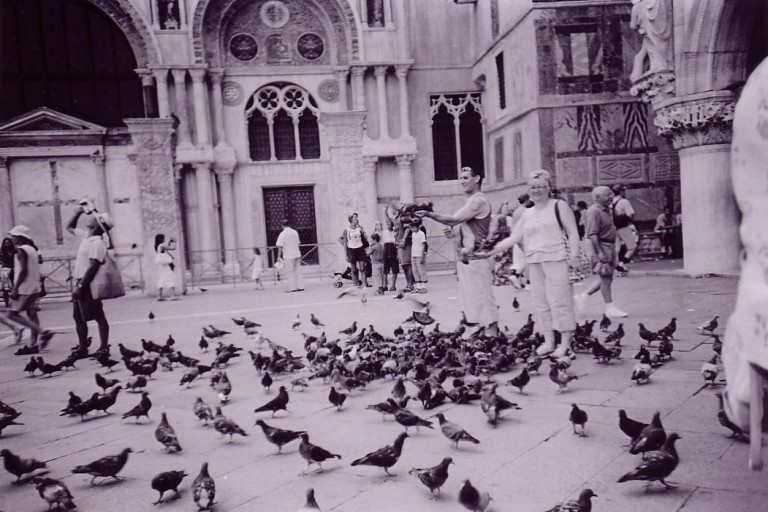
    A black and white lomograph of a flock of pigeons in the Piazza San Marco, Venice

    4.  Idiots. Pigeons attract idiots.  Look at this American woman in the Piazza San Marco, Venice.  She’s in one of the most beautiful parts of one of the world’s loveliest cities and she’s fascinated by the pigeons.  She’s clearly an idiot.  She could be looking at the Basilica, she could be looking at the Doge’s Palace, she could be looking at the Procuratie Vecchie but no, she’s looking at pigeons.  Stupid, stupid, stupid, stupid, stupid, stupid, stupid bloody pigeon-woman.

    5.  War. Pigeon excrement was the only known source of saltpetre (potassium nitrate) in 16th century England.  Saltpetre is an essential ingredient in gunpowder, so if your Tudor house was damaged by canon-balls or if your copotain hat was knocked from your head by musket-shot five-hundred years ago, you can blame pigeons.

    6.  Emasculation. Wood pigeons are the larger, nobler cousins of the urban pigeon.  Historically these creatures, with their quite pleasant and distinctive call, have been content to live in trees far away from people (who do not live in trees).  Recently though, a pair of these creatures have moved in near to a house belonging to a friend of mine.  Their favourite game is to poo on the love of his life (his shiny, expensive German car) and then to sit on his garden fence cooing at him.  They do this every day.  Not unnaturally, this makes him very cross.  If he could get hold of them, he would probably tear their heads off in a murderous rage, but every time he approaches, they casually retreat to a safe distance and continue taunting him.  It is because of this that he is now known as The Pigeons’ Bitch.  And because of me, obviously.  He should never have told me.

    7.  Profiteering. The use of a fleet of trained carrier pigeons was instrumental in the allowing the Rothschild banking family to make vast fortunes during the Napoleonic wars.   They were able to manipulate financial markets for their own gain, based on having exclusive access to early information about the results of battles.  Pigeons filled the bankers’ wallet (the Reverend Spooner himself would have been proud of that one, and astonished by the mental image).