7 Reasons

Tag: sound

  • Guest Post: 7 Reasons Why The Piano Is The Best Instrument Of All Time

    Guest Post: 7 Reasons Why The Piano Is The Best Instrument Of All Time

    Forget guitars. Forget the drums. Forget the bass. The piano is the best instrument of all time. Think we’re kidding? Well read on.

    There’s nothing more beautiful in the world of music that a piano concerto. It’s an instrument which (believe it or not) is easy to play, versatile and social – yet complex and steeped in history.

    With that in mind, here’s 7 reasons why we think the piano is the best instrument of all time – we hope you agree!

    7 Reasons The Piano Is The Best Instrument Of All Time

    1.  Teach Yourself. Although the piano is a difficult instrument to master, there is piano sheet music available for every level of capability, from beginner to expert. This means that, generally speaking, if a toddler has learnt to sit up properly, they can start learning to play the piano. These skills will then grow with them throughout their lifetime, accompanying and nurturing them whatever their circumstance. With a piano as their means for expression, they’ll celebrate life, lament loss and all the while continue to learn and develop as a pianist.

    2.  Versatility. The piano is an extremely versatile instrument. From freeform jazz to dreamy pop ballads, the ivories have been tinkered across a plethora of musical genres, and to great effect. Whilst other classical instruments, (flutes, trumpets, cellos) seem committed to their classical constraints, the piano transcends genre.

    3.  It All Starts At The Piano. Musicians from every field take to the piano because it offers an easy means for composition. Whilst it takes years of training to produce a simple note from woodwind or string instruments, the piano is the perfect platform for writing and rehearsing intricate melodic and harmonic arrangements. Once a piece of music has been composed, it can then be played on any number of instruments.

    4.  Sing-a-longs. Playing the piano is a very social, creative and unifying experience for everyone involved. Picture a soporific Sunday afternoon with the whole family stood around the piano, singing along to an old war tune. Sure, it sounds old-fashioned, but at least everyone is together and sharing in something positive. One person’s talent radiates into the lives of others which in turn encourages creativity and motivates musical innovation.

    5.  There’s Humanity In The Piano. The sheet music of Chopin, Mozart and Beethoven is centuries old and yet still extremely relevant. These pianists continue to resonate with listeners of today because they captured the essence of humanity and the complexities of emotion like no other instrumentalist can. Without lyrics for emotional manipulation or music videos as visual stimulus, these composers created something which everyone can relate to despite its apparent age.

    6.  Timeless Tinkering. And, surely, like the best wines, music only matures with time? Who will still be listening to Tinie Tempah in 200 years? Very few, it can be assumed. But names like Tchaikovsky and Handel and Schubert will remain eternally imprinted on the list of musical greats because they will always be significant. The piano has been around since the early eighteenth century and has turned men, who would otherwise have been lost to the sands of time, into musical deities. It’s rich and diverse history only accentuates its superiority.

    7.  One Instrument Band. The piano does not need the support of a choir, an orchestra or even a single voice. Whilst it’s versatile enough to cater for any genre, voice or orchestral composition, as a stand-alone instrument it’s powerful enough to lead a whole movement to a crashing and memorable crescendo.

    This guest post was written by www.musicroom.com. For all your sheet music needs, please visit our website for more information.
  • 7 Reasons That Vuvuzelas Are Annoying

    7 Reasons That Vuvuzelas Are Annoying

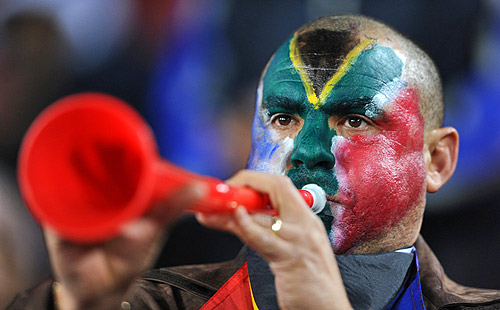
    A fan with South Africa face-paint blowing a vuvuzela, the horn from the 2010 South Africa World Cup (vuvuzelas)

    1.  The Obsession.  The nation is obsessed with the vuvuzela.  It’s impossible to read a newspaper, listen to the radio, watch the television, go to the pub, or read an internet humour site without someone bleating on about vuvuzelas.  But I think that this focus on the vuvuzela is causing us to miss out on other World Cup stories.  We’re just not getting enough ill-informed conjecture about problems with the ball: Is it that it’s too round? Is it the altitude?  Does it fly too straight?  Doesn’t it fly straight enough?  Does it look too much like a fly?


    The South Africa Football (soccer) World Cup 2010 ball, the Jabulani, as the head of a fly.  A fly's head.  Flies.
    It's a fly!

    All of the coverage of the vuvuzelas is preventing us from having what we really want.  24 hour per day coverage of the ball.  And more Robbie Savage.

    2.  The Name. The English language is a fusion of many languages from around the world and a lot of our words come from other countries.  We get bungalow from India, sepia from Italy, mammoth from Russia and surrender from France (rather unsurprisingly).  Yet it’s safe to say that our language wasn’t aided in its evolution by anyone who had been involved in professional football as, in the past week – from various players and former-players – I’ve heard “vuvulas”, “vuvuslas”, “the horns” and from Sir Geoff Hurst, no less, “uvuvezlas”. The awful mangling of the word vuvuzela is possibly the only thing that’s more grating than the sound of the instrument itself.

    3.  Stadium Atmosphere. The din of the vuvuzelas drowns out everything else occurring in the stadiums.  This isn’t always a bad thing, as it drowned out the sound of happy Germans on Sunday, but it drowned everything else out too.  The crowd reaction, singing, cheering, chanting, abuse; in fact, just about all of the things that reflect the partisan nature of football.  The drone of massed vuvuzelas is a relentless unremitting cacophany that doesn’t abuse the referee, ask Fabio to dance, play the theme from The Great Escape (sorry, poor argument); doesn’t do anything fun or interesting at all.  It’s just noise.  An incessant racket that drowns out everything good about the stadium atmosphere.  Everything.

    4.  Domestic Atmosphere. The vuvuzela operates at a similar pitch and tone to the human voice which means that, when you’re viewing the World Cup at home, you’re trying to filter out the frequency that other people in the room are speaking at.  Thanks to the vuvuzela, if my wife turned to me during a match and said, “Would you like a beer?” or “Jennifer Aniston’s at the door, she wants to know if you can come out to play,” I probably wouldn’t hear her.  Experience tells me that she’s unlikely to say either of those things, but what if she did and I missed it?  Catastrophe.  I hate going to the fridge.

    5.  Envy. It’s substantial, straight and three feet long, and I must say that I’m quite jealous, as there’s no way I could take anything like that to a football match in England.  I’d probably be fed to a police-horse or charged with possession of a vuva vovos avuvuvu…“I’ll let you off with a caution this time sonny, now on your way”.  We don’t even get trusted with bottled water over here.

    6.  Sound. The sound of massed vuvuzelas is like the sound of a swarm of angry wasps, but deeper.  Usually, the larger an animal is, the deeper the sound that they make – so it’s giant angry wasps that we’ll hear the sound of all summer.  Giant angry wasps!  Well I certainly won’t be falling asleep during a match, or at any time at all during the summer.  Except when Andy Townsend’s “analysing” the action, that is.

    7.  We’re Stuck With Them. There is only one thing that would be worse than enduring the sound of the vuvuzela: That would be banning the vuvuzela.  Just because we Europeans have our own expectations of how a football match should be viewed, it doesn’t mean that they should be forced on the rest of the world.  This is South Africa’s World Cup, and god knows they’ve earned it.  World Cup 2010 should be a uniquely African spectacle and, much to my annoyance, this includes that giant dung beetle thing from the opening ceremony and the bloody vuvuzelas.   But we shouldn’t be downhearted about this; sometimes the most memorable parts of World Cups are the unique things that the host nations bring to them.  Mexico ’86’s wave, Argentina ’78’s ticker-tape, Italia ’90’s Three Tenors and USA ’94’s blank incomprehension about some sort of soccer-ball tournament going on.  Long after many of the matches and incidents are forgotten, these are the memories that remain.  And so it will be with the vuvuzela.  We will have to suffer it for a month or so, but in time it’ll be the thing that the tournament is remembered for.  We may even feel nostalgia for it.  Eventually.

  • 7 Reasons to go and Watch Invictus

    7 Reasons to go and Watch Invictus


    1.  Morgan Freeman.  Usually the veteran actor gets typecast as God, but in Invictus he gets promoted and puts in a superb performance as Nelson Mandela.  His accent is a bit dodgy, but the same could be said of all South Africans.  Either that or they genuinely believe it’s called “Sowt Efrica”.

    2.  Rugby.  There aren’t many decent films about rugby and the depiction of the game is pretty good in Invictus.  It’s not up to the standard of This Sporting Life, but that’s almost 50 years old and is about the wrong rugby – the one they play in the North-West that makes you shout “For fucks sake, run around him” when you accidentally see television coverage of it.  Perhaps I’m missing some subtle nuance of that game, but why do they always run straight into an opposing player?

    3.  Crying.  Everyone loves a good cry – something I often tell myself when I’ve put my foot in it again, and if you’re prone to crying at sport or movies, you’ll definitely cry at the conclusion of Invictus.  Eastwood manages to wring just about every ounce of emotion out of the film’s climax.  If you’re at all sensitive, you’ll cry like a girl – even if you aren’t one.

    4.  Crying.  I didn’t cry like a girl while everyone else in the cinema was blubbing though.  Oh no.  I cried when Jonah Lomu ran amok with the ball and rampaged through the defenceless England backs.  It brought it all back to me; the big bully, those poor little mites, the carnage.  Oh, the horror.

    5.  Sound.  Want to hear rugby with improbable sounds dubbed on?  Of course you do.  Go and see Invictus.  Every tackle sounds like a gunshot within a biscuit-tin within a kettle-drum within an empty water-tank within an Airbus A340 flying through a thunderstorm.  The woman sitting next to me gasped during every tackle.  She may have been mental though, there’s usually one in every cinema.

    6.  England. As the film is based on real sporting events I’m not giving anything away when I tell you that Rory Underwood scores a try for England during the film.  This is great, though the rest of the audience will not thank you for celebrating it.  Trust me.

    7.  Matt Damon.  MAAAATTTT DAAAAAMMMON!!!!!  He is brilliant in Invictus.  His South African accent is convincing and he plays Francois Pienaar with a lovely, understated dignity.  He has also transformed his entire body to play the role.  The shot in which they show his upper torso is entirely gratuitous, but his musculature is astonishing – it is physical evidence of the dedication that he brought to his preparation for the film.  Being much shorter than the real Francois Pienaar, he had to stand on a box for several of his scenes.  I explained this to my friend before we went in to see the film. “Matt Damon’s pretty short”, I said, demonstrating his height with my hand at about chest level.  I then raised my hand above me, stood on tiptoes, and extended my right arm fully, “but Francois Pienaar’s enormous, he’s 6ft 3!!!  That’s…er…an inch taller than we are”.  I have already been made to feel quite silly for that, thank you for asking.

    Reblog this post [with Zemanta]