7 Reasons

Tag: religion

  • Guest Post: 7 Reasons To Holiday In Cambodia

    Guest Post: 7 Reasons To Holiday In Cambodia

    When celebrity chef Gordon Ramsay visited Cambodia as part of his Great Escape series, he didn’t exactly showcase the best this incredible country has to offer. Amongst other things, he caught and ate spiders and went hunting for frogs to serve as a dish. While we leave the eating of anthropoids to Gordon, here are seven reasons why Cambodia holidays are the way forward.

    7 Reasons To Holiday In Cambodia

    1.  Cambodia Holidays Are Easy On The Wallet. A typical meal from a street vendor will cost you $2 or $3 and from there the price to quality ratio keeps climbing. For $20 you can enjoy three unforgettable courses at ethical restaurants like Romdeng in Phnom Penh (part of a great NGO network). How about a main of Fish Amok finished off with a desert of deep fried sugar-rice dumplings served with ice-cream – sound good?

    2.  Angkor Wat? Well, actually it is one of the world’s finest religious sites. Yes, this 12th century Khmer and Dravidian temple complex is famous the world over. UNESCO protected Angkor was ‘rediscovered’ by tourism after the last of the murderous regime of the Khmer Rouge left towards the end of the 1980s and into the 1990s. Since then it has wowed tourists from across the globe. It enjoyed a particular spike in popularity after Angelina Jolie bought the dream of geeks – Lady Lara Croft – to the big screen in 2001. Angkor is the perfect addition to your holiday.

    3.  The People. Despite years of turmoil, from the horrors of the American-Vietnam war through the 60s and 70s and then the abhorrent regime of the Khmer Rouge in the 70s and 80s, Cambodians have faced their challenges with one large and enduring smile. Cambodia is home to hundreds of distinct cultures and its people can be found in the bright (ish) cities of Phnom Penh and (only really famous for being so close to Angkor Wat) Siem Reap. It is however, in the countryside & small towns where you’ll meet the real people of Cambodia. Quieter towns like Battambang offer a more unique insight to Cambodia life and really add that ‘cultural’ dimension to your holiday. As with all destinations just wandering the streets or embarking on a traditional home-stay are great ways to meet the people.

    4.  Beaches. No holiday is complete without some time in the beach. Cambodia southern coast is truly unique. Ever been to Hawaii, Kuta or Spain and seen what a thousand sun-burned bodies look like? Well, not in Cambodia – you have access to hundreds of miles of unspoiled beaches that offer views like Thailand but with half the crowds. Cambodia’s southern coast has a smattering of resorts. Sokha Beach is the largest and most popular (especially with backpackers) but Kep and Kampot (3 hours from the capital, Phnom Penh) offer solid holiday accommodation and real tranquillity.

    5.  Access. Getting there is a doddle. Cambodia is well serviced by the busy regional hub airports of Bangkok and Singapore that deal with holidaymakers the world over. After a neon-lit night of fun in Bangkok or cocktail-based revelry in splendiferous Singapore hop aboard your regional connection to Phnom Penh or Siem Reap to begin you holiday of a lifetime.

    6.  Accommodation. From 5* hotels such as the Hotel De La Paix (a favourite for celebrities!) or Raffles in Siem Reap to cosy home-stays in rural Cambodia, you will not be left wanting.

    7.  Tonle Sap Lake. No, not like many ‘lakes’ tourists are sold; Tonle Sap is a real lake. Not only is it a ‘real’ lake, it is also colossal!! In fact, it is the largest fresh-water lake in South East Asia. For those that like factoids its year-round average size is 2,700 square km. A visit is a must.

    Author Bio: Kian has travelled extensively in Asia. His favourite destination in Cambodia is the town of Battambang and his favourite holiday experience is watching the sunrise over Angkor Wat away from the crowds.

  • Guest Post: 7 Reasons For Fake Christmas Trees

    Guest Post: 7 Reasons For Fake Christmas Trees

    It is fair to say that there wasn’t a lot of fakery about the 7 Reasons HQ up until today – except maybe the dancing girls and the tiramisu tap – but that has rather suddenly changed. Today we find the 7 Reasons sofa in a forest. A fake forest. A fake forest of Christmas trees. And it’s all the work of today’s guest-writer, Andrew Norton. He likes them. And quite reasonably too.

    7 Reasons For Fake Christmas Trees
    Fake, fake, fake fake, fake.

    A common thread in many of these 7 reasons lists seems to be idleness – you should do this or that because it is easier, or quicker or less hassle and so on. In keeping with this and for the sake of avoiding having to think too hard, I will proudly use the same rhetoric here.

    1.  Laziness. Artificial Christmas trees genuinely are the laziest, easiest, least hassling component of the entire Christmas period bar none. Not all fake trees are this simple I grant you, but there are pop-up Christmas trees that exist that literally jump into action, pre lit and decorated. All you have to do is find enough time and energy to rise out of a chair or bed long enough to get the tree out of the box, plug it in and switch it on. 1-0.

    2.  Rashes. This one might not cover everybody and I accept that, but there are a lot of people allergic to pretty much everything Christmas has to offer be it nuts, fake beards or pine needles. If you are one of those people, the festive period need not be a time of rashes and annaphallactic shock. When it comes to your Christmas tree – get an artificial one. Unless you’re allergic to plastic as well, in which case you might want to think about creating your own tree out of baby wipes, pipe cleaners and moisturiser. However, chances are that a wily Santa will mistake it for a pile of junk and leave you only the dust, fluff and crumbs that gather in the folds of his enormous Christmas sack. That is not a euphemism by the way.

    3.  Needles. Obvious one this, but most certainly true. The biggest pain about going into a forest, removing a tree and bringing it back into the house is that it continues to behave like a tree and very much like one that is dying. It drops its needles everywhere as a result. And they are called ‘needles’ for a reason, just ask your cat once it has finished trying to dislodge one from its larynx. They get everywhere and need to constantly be hoovered up from the giant sticklebrick that they make of your carpet. Not to mention the collection you will find on the bottom of your socks – I guarantee it.

    4.  They’re Identical. OK, so just stop and think for a minute about what you are doing this time of year – taking a tree from outside where it belongs, cutting it down and bringing it into your house so that you can precariously balance it in an ill-fitting stand, cover it in fragile decorations and light it up to make it pretty and sparkly. While that is fun it is also pretty laborious and ridiculous. When questioned about it by aliens or foreigners, you will tell them you do it “just coz that’s what we do”. At least save yourself accusations of madness by admitting that it is crazy and get a fake tree that looks identical to a real one. You can then argue that it is a symbol of a symbol, a postmodern ornament in reference to a pre-modern tradition. Make sense? Thought not. Just get a fake tree.

    5.  Religion. Had you forgotten that Christmas has anything to do with Christianity? May I take this chance to remind you that the whole reason we have Christmas trees is because a few hundred years ago St. Boniface though it would be funny to go and chop down a sacred tree devoted to the Norse gods in order to disprove the Nordic faith by remaining unscathed from their deities’ wrath. He even brought it into the house and made a display out of it. Well, if you are Christian you can continue the tradition with an artificial tree just as well as a real one. If you are an atheist or agnostic you can remove yourself from the actions of St. Boniface because unlike him you bought yours from a shop that had absolutely nothing to do with Norse gods and is not imbued with any sacred life force.

    6.  Reusable. So Christmas is over and the stick in your living room devoid of needles looks like a shaved cat wearing bangle earrings. Are you happy now? Did you think to get one that comes in a pot and can go in your garden? No? Well, I suppose you’ll throw it away or get it chipped. Yes, it may return to the earth from whence it came and that’s great. But so will an artificial tree. Well – in that you get it down from the attic each year and then when you’re done it returns to whence it came. They just pack back up into a box and ‘hibernate’ like all the other things you forget you own up in the forgotten world of sleeping curios in the loft.

    7.  Choice. Trees are green and are made of wood. The end. Artificial trees are all singing, all dancing magical constructions that take anything a real tree can do and then go one further. What’s more they are the tree equivalent of John C. Reily. They, like he, can play it straight or for laughs to equal aplomb. Remember him as the doomed fisherman in a Perfect Storm? That’s an artificial tree playing the part of a traditional Nordman Fir – compelling, believable and a joy to watch. Remember John going full slapstick with Will Ferrell in Step Brothers? That’s an artificial tree giving it as a pre-lit pop-up fibre optic mutli-coloured festive grotto in a box. Beat that real tree.

  • 7 Reasons That Ricky Ponting is the Second Coming of Christ

    7 Reasons That Ricky Ponting is the Second Coming of Christ

    As I was walking yesterday, on the road to Sainsbury’s, a strange and life-changing event occurred.  I strolled past a man carrying a newspaper and, upon the back of that newspaper there was a picture.  An image of Ricky Ponting looking glum.  Christ, I thought, doesn’t that miserable bastard ever look happy? And then, suddenly and without warning, there was a blinding flash of light and a sonorous and divine voice did appear from the sky and say, “Ah look, mate, why do you persecute me?”

    I fell to the floor:  “Who are you,” I stammered meekly.

    “I am Punter, whom you are persecuting,” he replied.  “Now rise and get thee unto the supermarket, and you will be told what you must do.”

    Blimey, that was weird, I thought, and went to the supermarket as I was bidden.  And, to cut a very long story short, in the manner of Saul on the road to Damascus, I, Marc* on the road to Sainsbury’s, had had an epiphany.  I realised that I had been wrong all along about Ricky Ponting and had done him many disservices over the years.  And now I have truly seen the light and it is my divine mission to tell the world of his glory; here are the seven reasons why Punter is the true successor to our lord Jesus Christ.

    Punter as Christ
    Ricky, as he appeared to me on the road to Sainsbury's.

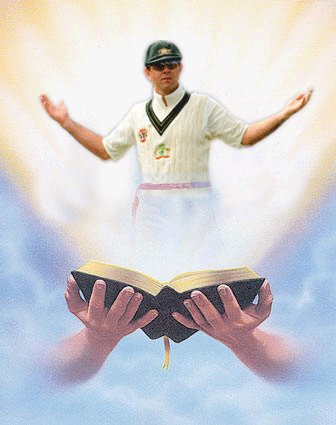
    1.  The Name.  If things look right, and sound right, then they generally are.  And when I tried to think of a way to link the names of Jesus and Ponting, I have to admit, I struggled.  But then I realised that true struggle is the lot of a disciple, and that I’d just have to think harder.  And, lo, I thought harder.  But other than the names Ponting and Christ being interchangeable as profane expletives in my heathen life prior to my conversion, I could find very little to link them.  Then it hit me:  A portmanteau word.  Ricky Ponting is no longer merely Punter the cricket captain.  He now has a divine and biblical-sounding title.  He will henceforth be known as…The Pontychrist.

    Ricky Ponting as Jesus Christ rising angelically from a bible
    Ah, look. It's the Pontychrist!

    2.  Miracles.  Jesus was famed for his making of miracles.  Specifically, for eking out very little, to make a lot.  He turned water into wine, and he fed five-thousand people when equipped with a small quantity of bread and fish; a situation in which a lesser bearded-man – such as Captain Birdseye – merely invented the fish finger.  And, in the manner of Jesus, Ponting (who, though not bearded of face, is bearded of arm), the new saviour, is attempting to win the Ashes with a mere nineteen runs from the first two tests.  And when he pulls it off, it will be hailed as one of the greatest miracles ever seen.  Greater, even, than when he takes a stroll across Sydney Harbour without using the bridge after the fifth test, and greater than when he turns Toohey’s into wine.  Or Beer into a world-beating bowler.

    3.  Serendipity.  This current Ashes series began in almost an exact word-for-word replay of one of Christ’s most famous quotes because Australia opened the bowling in the first test.  And so it was that he, who is without spin, cast the first stone (or ball, as we call them these days).  In fact, like his famous forebear, Ponting tries as much as possible to live a blameless life where lesser men (England) are happy to live a life of spin.  In the grand tradition of divine saviours, The Pontychrist is more spinned against, than spinning.

    4.  The Devil.  There would be no need for the coming of Ponting if it weren’t for the presence of darkness among man.  Who then, is his nemesis, his bête noire, his archfiend, his foe, the Mephistopheles to his Good Shepherd?  It can’t be Andrew Strauss; he’s too nice, he is a mere instrument of the devil.  For Beelzebub himself is cunning, yet is vain, and so gives himself away through his choice of name.  I ask you, what rhymes with horn?  That’s right, many, many, many things but, specifically in this case, Vaughan.  Behold The Antipontychrist!  For though he has now been banished unto the commentary box for the duration of the series – which if the final test ends on day three will have lasted for forty days and forty nights – (which is both biblical and mathematical proof ), he is surely the puppet-master that the righteous Punter does battle against.

    Former England Cricket Captain Michael Vaughan as The Devil
    The name of the beast is The Antipontychrist and his number is 6-0-0 (and he doesn't look very well)

    5.  The Blood of the PontyChrist.  In Christian religions, those arcane churches that we had before the birth of Pontianity, especially in Roman-Catholicism, (where the head of the church will, when Ponting is acknowledged as the second coming, be known as The Puntiff) the blood of Christ is important.  Jesus, we are told, bled for our sins, and so, in the present day, has the Pontychrist.  Here he is bleeding, so that our spirits may be lifted heavenward.  And who amongst us can say that this image of  his selflessness doesn’t fill their heart with joy?

    Punter bleeding from the mouth after being hit by the ball while fielding
    We have redemption through his blood…in accordance with the riches of God's grace.

    Rickey Ponting, Australia Captain, spitting blood after being hit in the face by a ball while fielding
    Yes, this one's just gratuitous.

    6.  Iconography.  And, much like Christ, when so many of his teachings will be open to the whimsical and wilful interpretations of man, many years after he has passed, so the Pontychrist’s visage will be used, in the millennia to come by men warning others to follow his example and to live without sin.  He’s omnipresent, they’ll say, he can see everything that you’re doing, they’ll say.  And they’re right.  In this portent of the future he seems to be staring into your very soul.  And, now that you have seen this picture, you will know, that Ricky can see your every thought and deed.  He will know if you think ill of the French.  He will know when you’re masturbating.  He will know when you’ve eaten Twiglets that you shouldn’t have touched.  He knows everything:  For he is omnipontent.

    Ricky Ponting as Christ on a billboard.
    He can see into your soul, you bad, bad person.

    7.  Reflection.  And later, on reflection at my conversion to Pontianity, I had a moment of doubt, the sort that afflicted people 2000 years ago in Jesus’s time.  I wrote this piece yesterday, but when I woke this morning, I found myself questioning things.  In short, I had a crisis of faith.  I might have taken too much of my flu medication yesterday, I thought.  What if I’d dreamt it?  I’d look a fool.  I’d be mocked and cast asunder by my peers.  I decided that, on reflection, I may have got carried away and resolved to discard what I had written and start afresh with a new piece, after I’d had my breakfast.  And then I saw a sign:

    The image of Ricky Ponting appears on a slice of toast.  He's like Christ.
    It's a sign! (a tasty one, too).

    So, in summary, I’m buying myself a ute and I’m going to fill it with corrugated iron and tambourines and head off to the hills to build the first (of many) Puntecostal churches.  Who’s with me?

    *Henceforth to be known as Parc.

  • Guest Post: 7 Reasons Great Britain is Better Than the United States of America

    Guest Post: 7 Reasons Great Britain is Better Than the United States of America

    Today’s guest post comes courtesy of globe-trotting, observation-jotting, ale-totting, train-riding man of both style and substance, Simon Best.  The last guest post that he wrote for us, 7 Reasons the United States of America is Better Than Great Britain, was such a success that Simon has come back to wholly contradict himself.  Based on this evidence, it may appear to those who don’t know Simon, that he could start a fight in an empty room.  This is not true.   Simon is a pacifist and, as such, would probably give himself a stiff talking-to and then reconcile with himself over a nice cup of tea – which would also be the ideal accompaniment to this.


    Photo montage featuring the statue of liberty, a boiled egg with toast soldier, The Queen, trains, cricketers playing a cricket game and a cup of tea.

    1. Tea. Quintessentially British. We displayed our attitude to tea by naming a type of tea after a nobleman, the Americans showed theirs by chucking box-loads into grimy water – without stopping to boil it first or add milk once it had brewed. This attitude has continued and most of the tea you find in America is herbal, fruity, decaffeinated and an abomination. Tea was what started the American war of independence, I know it led to the loss of a large colony but quite frankly, if they were prepared to do that with tea rather than sit down and have a chat over a cuppa then we’re better off without them.  Fast food, instant coffee, drive-through restaurants, shock and awe – all American inventions and all about speed. In Britain we stop for tea. It’s an occasion and one the world’s only superpower could learn from. I think that pretty much every world problem could be solved by sitting down and talking over tea and cucumber sandwiches. President Obama take note, now you’ve won the Nobel Peace Prize you need to start having afternoon tea – it is the next step to world peace.

    2.  Language. The use of different phrases; trash can, for example, or parking lot is understandable and forgivable – after all, different parts of Britain use different words and phrases to refer to the same thing. What is not acceptable is spelling favourite without a ‘u’ or pronouncing ’herb’ as ‘erb’ unless they are talking about an elderly gentleman in a Hawaiian shirt.  American readers, look at the word again – there is a letter ‘h’ at the front. Pronounce it.  It really isn’t that difficult.

    3. Cricket. America has three huge sports, and a few people play ice hockey too.  American football, baseball and basketball are skilful and exciting sports. They even play football (or soccer) in America, and I’m not going to say anymore about that in case they beat England in the World Cup. What Americans don’t do is play cricket. I thought I didn’t need to say more than this, but I was told I couldn’t just stop there, so here goes; cricket is more stylish, more testing, requires greater all round ability, patience and superior tactics worked out with military precision – all of which can be thrown out by the weather. The closest America comes is baseball, which is essentially cricket for people with ADHD.

    4. Monarchy. Having written this about a month ago I could reasonably be accused of treason against Her Majesty Queen Elizabeth the Second, by the Grace of God, of the United Kingdom of Great Britain and Northern Ireland and of Her other Realms and Territories Queen, Head of the Commonwealth, Defender of the Faith.  This reason isn’t an attempt to make amends for that because I’m not talking about the current royal family who, quite frankly, I have little time for. I know that Americans love our royal family, they loved Princess Diana so much that 64% of their citizens wanted to crown her Queen of Rhode Island*.  However, I am talking about Kings and Queens past: Canute who demonstrated he was only human by proving to his subjects that he couldn’t turn back the sea, Alfred who inspired the invention of the oven timer, Henry VIII who (allegedly) wrote Greensleeves and Victoria who was grandmother to most of Europe’s monarchs at the time of World War I. Americans would love to have that kind of heritage.

    5. Trains. I know First Capital Connect are rubbish and Southeastern Trains couldn’t organise a piss-up in a brewery, but the British rail network is infinitely better than that in America. Yes we have delays, and being sat for half an hour in a siding outside Grantham is frustrating, but when travelling in Britain I’ve never been delayed by 17 hours – as I was when on a train from New Orleans to Los Angeles.  Americans claim to have conquered the West with the railroad, but modern trains and railways in America are rubbish; there are huge cities like San Francisco, Phoenix and Boulder, Colorado with no station. That’s like there being no station in Glasgow, Bristol or Cardiff. Services are also ridiculously infrequent; there is one train a day between Chicago and Los Angeles. Imagine missing the 16:04 from Paddington to Exeter and being told that the next train is at 10:37 tomorrow morning. In Britain we have bad railways and complain about them, giving us something to talk about. In America they have bad railways and fly everywhere.

    6. Religion. Like the worst dinner party guest, I am going to address one of the subjects you are supposed to avoid in polite company. In Britain, religion is a nice add-on to life, a way of people coming together to eat scones and have jumble sales with a bit of (usually insipid) singing thrown in. It is comfortable, like a favourite cardigan or a pint of ale. In America, religion is full-on – fire and brimstone – like being forced to wear a hair shirt in 90 degree heat (which if you are Amish you probably are).  Religion is still just as important to British people as it is to Americans – we just handle it better. We don’t care which church our politicians go to, or even if they go at all. We, rightly, have little interest in their Sunday morning activity (providing it doesn’t involve cruising on Clapham common or snorting cocaine with prostitutes). In America, the thought that an elected official might not be a regular churchgoer would be scandalous and there are frequent and heated debates about whether to allow prayers in state schools, or if it is ok to have the ten commandments on tablets of stone in a courtroom. In America, the separation of church and state has happened in law; in Britain, it has happened in reality.

    7.  Breakfast. America has perfected the breakfast egg, which is available in a bewildering variety of styles, but we have something wonderful over here; something that transcends mere bread, a brilliant, culinary exemplification of form following function and the perfect accompaniment to an egg – the toast soldier.  Simple, tasty, ingenious; the toast soldier is guaranteed to enliven any eggy breakfast – it also turns up in time for the start of the breakfast, not several years after it has begun.

    *This figure isn’t statistically verifiable.