7 Reasons

Tag: Barclays

  • Guest Post: 7 Reasons Bob Diamond Had To Go – Shine On You Crazy Diamond

    Guest Post: 7 Reasons Bob Diamond Had To Go – Shine On You Crazy Diamond

    In the past few weeks Barclays big dog Bob Diamond has seen more turgid inches than Katie Price in her pomp. Column inches that is (of course, what were you thinking?), as the Barclays Libor scandal has flipped a plethora of wigs in the financial world – and in this sphere there are plenty to flip.
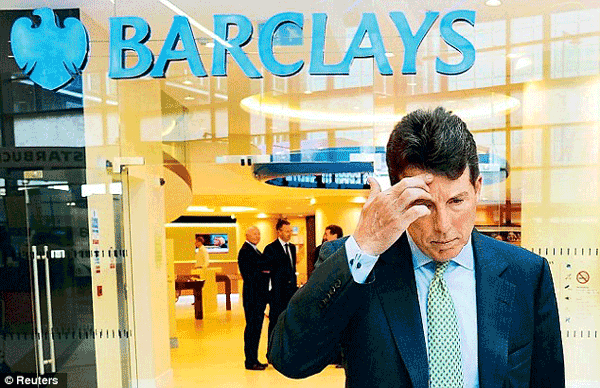
    Bob Diamond ©Reuters

    Diamond and co-conspirators (or clueless simpletons as many have claimed, trying to avoid the axe), passed the buck so much that it got misplaced. Thankfully it was recovered from the lost and found and pinned securely to Bob’s head, which was now very much on the block. So, why exactly did the Barclays boss have to go? I can think of, hmm, 7 reasons:

    1. What’s in a name? Well… Judging people by their name is just wrong. It’s unfair, prejudiced, illogical and stupid. But Bob Diamond – really? Bankers should be trustworthy and reliable. It could be hypothetically scientifically impossible for anyone named Bob Diamond to be trustworthy. I got a GCSE in science – well I took a GCSE in science – so I should know. I’m pretty sure that Bob Diamond is a name designed specifically for second hand car dealers and scrap metal thieves. Would you trust a Bob Diamond with your money?

    2.  All that glitters… The Barclays scandal arose because Bob (yes I know him well enough to call him Bob now), apparently ordered the fixing of the Barclays Libor rate. This is the rate at which banks lend to each other and it indicates the financial position of an institution. Betting and trading on currency rates and market movements is one thing, but fixing is quite another. By doing this Bob was suggesting that Barclays was in a better position than it was. Naughty Bob!

    3.  A hole in the head for business. This fixing clearly indicates that – as well as being deceitful and dishonest – the Bobster has a hole in the head for business. Oh Bob why did you have to go and ruin a good career in investments, wealth management and other pecuniary matters with this scandalous move? Some critics have claimed it’s because he’s American; others that it was a cry for help; others that this was just the first time he was caught.

    4.  Blood ‘Diamond’ Conflict. When it became public knowledge that the Barclays Libor rate had been fixed, it ‘proper kicked off’ at the bank, as the Financial Times reported (or some other, perhaps imaginary publication). As mentioned the buck was passed furiously but among all the dizzy bankers, it was Diamond whose blood they were after. It was Diamond that had to go, as well as executive chairman Marcus Agius.

    5.  Diamond not a banker’s best friend. Squirm as he might Bobby couldn’t escape his fate; especially after he was grassed up by ‘right hand man’, Barclays executive Jerry del Missier, who told the Treasury Select Committee that Diamond had order him to fix the Libor rate. Bob was even less popular when the bank was hit with fines of £290 million.

    6.  Parliamentary porkies? The final nail in the Bob-shaped coffin was the accusation that Diamond lied to MPs about the scandal, showing again his charming proclivity for untruths that every good banker should have.

    7.  Bobby bonus. So it was decided/insisted that Bob would have to go, but as he clears his desk the £2 million bonus and benefits he will receive will soften the blow a little. It’s the least he deserves for deluding a trusted bank and a country in economic strife. God bless you Bob – shine on you crazy Diamond.
  • 7 Reasons To Answer The Phone By Saying ‘Goodbye’

    7 Reasons To Answer The Phone By Saying ‘Goodbye’

    There are moments in life, when you wish you had not picked up your phone. And then there are moments when you don’t answer your phone and you wish you had. Thanks to 7 Reasons, that dilemma is now over. Here are 7 Reasons to say ‘Goodbye’ as soon as you pick up that phone.

    7 Reasons To Answer The Phone By Saying 'Goodbye'

    1.  Cold-Callers. Double-glazing, health insurance, wills, bouncy castles, grandmothers. People will try and sell you anything these days. And, no matter how much you try saying it, ‘no’ just doesn’t seem to work. Get in a ‘goodbye’ straight away and while they are baffled by your audacity, hang up.

    2.  Barclays. I am using Barclays as an example as I have had first-hand experience of their call centres. I am sure, however, you could substitute the company for any other business that has it’s call centre in a foreign clime. Barclays had the foresight to base its call centre in the subcontinent. Which would have been absolutely fine if it had then employed people who could speak English adequately. Unfortunately, they failed in this pursuit. If indeed it ever was a pursuit. I’m sorry, but I simply can not understand what the hell they are talking about half the time. Actually, make that ninety percent of the time. And that is not an environment conducive to conversation. It’s like a Liverpudlian meeting a Geordie in Birmingham. Painful. Given that I am not going to understand them and they are not going to understand me, it’s worth halting the proceedings before they’ve even started.

    3.  Sanity. Some people – normal people – have a habit of talking to themselves. They can’t help it, it’s just natural. No amount of determination, threat or hypnosis can stop them. Which is where we come in. If you suffer from this narcissistic problem, call yourself. As soon as you answer, say ‘goodbye’. It will be the closure you have been searching for.

    4.  Tossers. These are the people that just love to have the last word. So, if you get the last word in first, you’ve won.*

    5.  Reverse. Given that the most important details are spoken about at the beginning of most phone conversations – and they are then forgotten once you have discussed sport/shoes, sport/the next door neighbours and sport/Eastenders – it is surely worth reversing the whole event. Start by saying ‘goodbye’, then talk about sport/rubbish, then the important item and then finish with a cheery ‘Hello’ or another form of salutation.

    6.  It’s Over. Splitting up with your partner is never a particularly joyous occasion. Even if it means moving on to better things. Finding the right words and a suitable environment to break-up in, is not a straight-forward affair. Sure, the advent of facebook and the relationship status option has made things easier if you are shallow, but what if you’re not? What if you are someone who agonizes over such a situation? Well, the next time they call, it’s time to say ‘goodbye’. And when they phone back, say it again. Repeat until they get the message. (You could also text them).

    7.  Bargains. Who knows how the person who has just called you will react when you say ‘goodbye’, but if they misunderstand what you are saying they may rattle off a load of ‘good buys’. As a result, you may end up investing in a BMW, a George Foreman Lean Mean Fat Reducing Grilling Machine or a slice of carrot cake. And no one can really complain about that, can they?

    *Sometimes I astonish myself with my own genius.

  • 7 Reasons That The Westbourne Bank Protest Was Stupid

    7 Reasons That The Westbourne Bank Protest Was Stupid

    In Britain, it’s often said that we’re not very good at protesting, and we’re always compared unfavourably with the French in that regard.  But now, public protest in the UK has reached an all-time low because, last weekend, several men in Dorset bricked up the door of their local bank in what they claimed was a, “…protest against the reluctance of banks to lend money to small firms”.  Here are seven reasons that their protest was stupid.

    Barclays bank in Westbourne, Dorset, being bricked in by protesters (Cameron Hope)

    1.  They Went To The Wrong Bank.  The protesters wanted to brick up the door of the Westbourne branch of Natwest Bank because it had refused the group’s ringleader, Cameron Hope, a business loan.  But, when they arrived at the Natwest, the police were nearby, so the group decided to brick up the door of a different bank instead.  Barclays.  Now, if I do something that irritates my wife involving…ooh…I don’t know…umm…a bicycle, for example, and I’m not there when she finds out about it – or I’m standing near the police – I wouldn’t expect her to go and yell at a different man.  Because that would be crazy.  And irrational.  And yes, it would be much better if she did that, but that’s not the point.  Bricking up the door of a bank that they didn’t have a legitimate grievance with is just mad.  And counter-productive.

    2.  Prudence.  Okay, so the bank turned down Cameron Hope’s loan application.  What should he do?  Scrimp and save, perhaps.  Look at alternate ways of raising capital, or go to a different bank.  I’m not a businessman, but I wouldn’t choose to demonstrate my financial acumen and creditworthiness to another bank by frittering my money away on costly building materials and then use them to construct a monument to my own profligacy on their doorstep.  Because that’s not going to help.  And it’s a lot of effort.  He could have achieved the same effect by setting fire to twenty pound notes in front of the bank manager instead.  Far less trouble.

    3.  Put Simply.  The more money the bank has, the more they’ll lend, making it more likely that you’ll get a loan.  Conversely:  The less money the bank has, the less they’ll lend, making it less likely that you’ll get a loan.  So if you brick the door of the bank up, customers can’t take their money to the bank, and then the bank can’t lend it to you.  I realise that this is a highly simplistic, microeconomic description of banking, but I’m addressing it thus, to the protesters because of…

    4.  The Quote.  The quote tells us that the protesters don’t understand how banking works at all, because one of the group stated to journalists, “You go into a bank and there’s nothing there, the bank’s open but the safe is shut.” This is his summary of his grievance with the banking system; and it doesn’t really bear much scrutiny.  Because of course there’s nothing there.  What does this man expect to find in a bank?  Displays of money?  Shelf upon shelf of alluringly-arrayed notes and enticing floor-displays brimming over with a boundless abundance of shimmering coins?  And of course the safe is shut.  It’s a safe.  That’s its job.  If the bloody things weren’t meant to be shut they’d be called something different.  They’d be called unsafes.  Or vulnerables.

    5.  Helping The Bank.  The protesters bricked up the door of the bank on a Sunday:  A day when all banks are closed.  So this had no effect on the bank’s ability to trade.  In fact, one of the major obsessions and expenses of any bank is security, and by bricking up the door – and thereby making it more difficult for robbers to enter the premises – the protesters actually helped the bank.  Not to mention that their protest also brought the police along to stand outside in hi-vis jackets, which probably made the bank as safe as it’s ever been.  And all at no extra cost to the bank.  What are the protesters going to do next, try to bring down the Conservative party by voting for them?

    6.  Consequences.  Though the protest didn’t have any serious consequences, it could well have done.  The protesters could have endangered the nation’s economy.  By bricking up the door of the bank, they made it likely that employees would have to enter and exit the premises via the windows.  And, as history teaches us, bankers jumping out of windows is one of the worst economic indicators that there is.  Worse even than Alistair Darling’s eyebrows.  It’s the sort of thing that, if the media get hold of the footage, can shatter fragile economic confidence.

    7.  Achievement. As a protest against banking it doesn’t appear to have accomplished anything.  I was in the centre of a city yesterday, and banking appeared to be going on pretty much unhindered by the protest. People in polyester uniforms were sitting around near potted plants in waist-high partitioned areas looking depressed, as usual.  The cash machine outside was covered in the remnants of a McDonald’s milkshake, as usual.  I wanted to thump over 90% of the people in the queue, as usual; even myself.  So the protest has had no discernible effect on banking.  Obviously, the protest brought an awful lot of free publicity for the property developer behind it, but that wasn’t the point.  Because this was a protest against banking, right?  And not some sort of tawdry self-serving publicity stunt?